

Articles
One baby equals two unwritten books
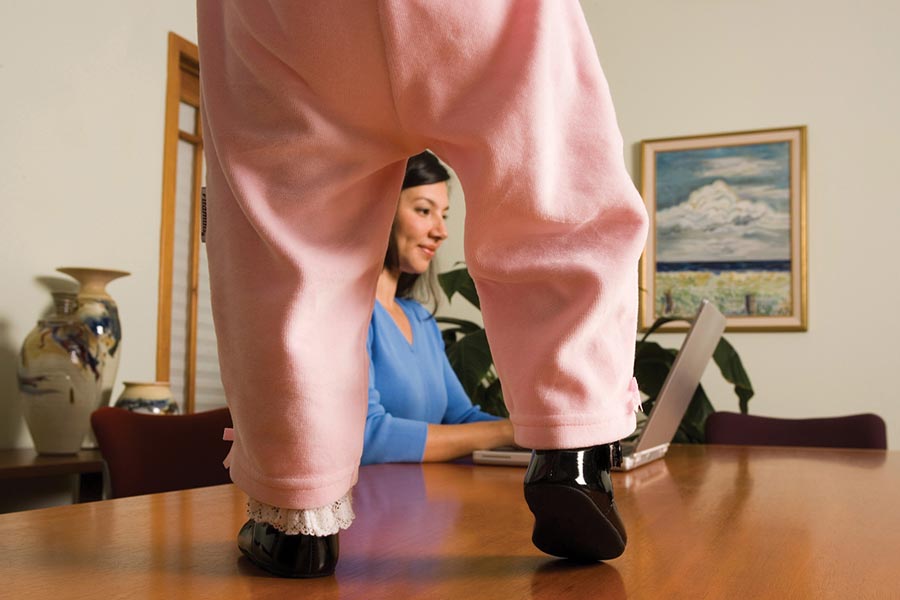
Novelist Candia McWilliam once famously declared that the time taken up caring for a young child is the equivalent of two books its mother might otherwise have written. Debbie Taylor counts up the creative cost of motherhood
(This feature was first published in Mslexia, in October 2004.)
People often refer to their books as their ‘babies’, but in my case it has been spookily true. The plot of my first novel started with the conception of a baby in Zimbabwe and culminated with her birth. The book took me nine months to write, during which time I completely stopped menstruating.
My next book, a travelogue, also took nine months to write – but this time I actually was pregnant when I was working on it. My daughter was conceived the day before I started writing, and I went into labour the day after the book was finished.
With each book, I worked intensely, with no interruptions: alone on a Greek island for the first book; with my partner in an isolated Scottish cottage for the second. I spoke to almost no-one and did almost nothing except write. All things being equal, then, nine months seems to be the time it should take me to write a book.
But after my daughter was born, all things were suddenly not equal. And my next novel took 10 years to complete. In fact it was the experience of motherhood – and the dismaying effect it had on my creative output – that prompted me to start Mslexia.
Feeding my daughter in the middle of the night, strapping her into the car-seat, dangling my car-keys in front of her for hours, I became aware of how very difficult it was for women with children to find the time, energy and mental space to tackle any major piece of creative writing. And I began to see that this might be one reason why the lists of literary prize-winners have been so dominated by men for so long.
Tillie Olson called the phenomenon ‘silences’: those gaps in an author’s life when they stop writing (Silences, Virago 1980). Almost all writers with children have them. ‘You lose your brain,’ Margaret Atwood told me, explaining the lacuna on her CV that coincided with her daughter’s early years.
When I say ‘all writers with children’, of course I mean ‘all women writers with children’. Because, as psychologist Livia Polman discovered when she looked in detail at the lives of creative writers, most male writers have wives to take care of the children and a sacrosanct ‘room of their own’ to write in. Fatherhood impacted hardly at all on the work of the male authors she studied, whereas for the women writers the effect was little short of devastating (Journal of Creative Behaviour, 1996).
Over the last few weeks I’ve read over 30 first-person accounts of motherhood – from poet Adrienne Rich’s passionate Of Woman Born (Bantam Books, 1977) through to novelist Rachel Cusk’s anguished A Life’s Work (Fourth Estate, 2002). By the time I’d finished, I was reeling from the cumulative effect of all that anger and disillusion. Apart from Anne Enright – who bounced exuberantly through her daughter’s first year and wanted to have another baby as soon as possible – every woman agreed that although they adored their children, they found the experience of motherhood frankly traumatic.
‘Sometimes I would be playing with her quite happily,’ wrote Sara Maitland in Why Children? (Women’s Press, 1980), and then ‘a complete and profound anger would come over me and I would want to kill her.’ Adrienne Rich describes herself as being ‘blotted out’ by motherhood; Sylvia Plath as being ‘flattened’ by it.
Motherhood hits us like a steamroller and it seems many women writers find its challenges especially hard to endure. Indeed research cited by Susan Maushart in The Mask of Motherhood (Pandora, 1999) has shown that the more intelligent and educated a woman is, the more likely she is to experience depression after the birth of her child.
We need our solitude. We need periods of concentration and reverie. We need to be able to close the door on the rest of our lives. But for a mother the door is always open.
‘The mother and the writer seem to live in two very different parts of my brain,’ writes novelist Maggie Gee in Fruits of Labour (Women’s Press, 2001). ‘The mother has to be pliable, adaptable, other-centred, personal, emotional; the writer needs detachment and a degree of steel.’ ‘As the baby grows, the mother shrinks,’ says novelist Rachel Cusk. ‘To be a mother I must leave the telephone unanswered, work undone, arrangements unmet. To be myself I must let the baby cry.’
Indeed it was the experience of motherhood that inspired the so-called ‘women’s novel’ of the Sixties. Looking back at that era, Margaret Drabble says: ‘The freedom was a mockery because we were all overloaded, exhausted. The women’s novel just rose spontaneously, with Edna O’Brien, Doris Lessing, Penelope Mortimer, and a little later Fay Weldon, beginning to express those feelings of rage.’
Thirty, 40 years on, a new generation of women writers is being hit by the same steamroller. Commissioning editor at Thorsons, Wanda Whiteley, told me that she was inundated by proposals from thirty-something journalists wanting to write a ‘warts and all’ book about new motherhood.
Many of the accounts I’ve read present motherhood as an altered state of consciousness that bludgeons a woman’s sense of autonomy. ‘I begin to feel like a stretch of unprotected wilderness ringing with the shriek of chainsaws,’ writes Rachel Cusk. Julia Darling describes walking around in ‘a mindless milky state’ and Anne Enright talks of ‘the shift from language that has happened in my brain’.
There is a tendency to ascribe some of these changes to the hormones that flood the brain during pregnancy and breastfeeding. But everything we know about female hormones indicates that they have a beneficial effect on mental functioning – and that this is likely to be one reason for women’s superior verbal skills. In fact research at the University of Sunderland investigating whether women’s minds really are affected by childbirth, found that, although new mothers believe their brains have turned to blancmange, they actually score just as well as non-mothers on tests of mental functioning. Other research, cited by Anne Enright in Making Babies (Jonathan Cape 2004) – albeit with rats this time – reveals that the hormones associated with lactation improve problem-solving abilities.
So though we may feel brain-dead after our babies are born – I certainly did – it seems we are almost certainly mistaken. From an evolutionary point of view, this should not surprise us. We would not have survived very long as a species if mothers lost their mental agility at the very time it was most needed to protect and nurture the next generation.
The focus on the experience of motherhood, on the self and how it is threatened by the needs of a helpless infant, conceals the fact that most of the problems of motherhood can be boiled down to three ennervatingly mundane factors: the sheer amount of work involved in caring for young children, the absolute necessity for that work – and the fact that men do almost none of it.
The additional work mothers do was dubbed ‘the second shift’ by Arlie Hochschild and Anne Machung in their book of that name (Avon Books, 1990). Hochschild and Machung pointed out that mothers with full-time jobs do twice as much domestic work as their husbands – an additional 15 hours per week, in fact, or the equivalent of two entire working days. This glaring domestic inequality has been described by Melissa Benn (in Madonna and Child, Jonathan Cape, 1998) as ‘one of the most important statements made about women today’. ‘Every study of working mothers shows they are stretched to the limits of endurance,’ she writes.
But for women writers with children, the second shift is actually a third shift. This is because few writers are able to live on the income from their publications alone, so most of us have day jobs too, which squeeze the amount of time we are able to spend writing. No wonder so many of us lapse into silence when we have children. ‘I stopped writing poetry and read little except household magazines and books about childcare,’ wrote Adrienne Rich. ‘I stuffed the writing in a drawer and forgot about it for 10 years,’ says Barbara Trapido.
As I type this, I can feel a tide of exhaustion welling up in my chest: because it seems I’ve been banging on about men’s domestic phobia ever since 1985, when I was commissioned by the United Nations to write the portentously-titled Report on the State of the World’s Women (published by Methuen that same year as Women: A World Report) and concluded that gender inequality was due primarily to the skewed division of labour in the home.
Twenty years on nothing – literally nothing – has changed. As Rhona Mahoney wrote in Kidding Ourselves: Breadwinning, Babies and Bargaining Power (New York Basic Books, 1995): ‘The glaciers have receded and mammoths are extinct, but this relic of the Pleistocene still slouches across our living rooms.’
Melissa Benn describes the typical working mother as ‘whey-faced, perpetually distracted, perpetually passing from one world to the other, never feeling fully present in either’. Little wonder only 15 per cent of top managers in the UK are women – and only one in 10 of them have children. Research in 1991 found that the birth of a first child increases women’s domestic work by 91 per cent to nearly 56 hours a week – but that their husbands’ domestic work does not increase at all.
Linda Kelsey, who as editor of She magazine famously complained, that far from ‘having it all’, modern women were ‘doing it all’ instead, was herself felled by a stress-related depression brought on by the strain of juggling a top publishing job and mothering her children. Indeed, according to research cited by Melissa Benn, half of British mothers with children under five experience symptoms of intense emotional distress ‘on a regular or continual basis’. As journalist and commentator Suzanne Moore says: ‘The issue does not seem to me to be one of men’s inability to shake off social conditioning, but of men’s refusal to give up a good deal.’
New Men are the worst. Not because they do less domestic work than unreconstructed rednecks – according to Naomi Wolf (in Misconceptions, Vintage 2002), they do precisely four minutes more – but because we believed they would do more. Many of the recent first-person accounts ring with this sense of betrayal. Yes, we knew motherhood would be hard work; we’d seen how it stifled and stymied our mothers’ ambitions. But we believed it would be different for us. We believed our men would be different.
But they aren’t. Yet the work has to be done. So we adopt what Naomi Wolf calls the ‘King Solomon Strategy’ and do it ourselves, rather than see our children suffer. ‘The prospect of endlessly negotiating the division of household labour with an unwilling or unable partner often seems more daunting than doing it all yourself,’ writes Melissa Benn.
What’s more, many of us feel grateful for the risible amount of help we get from our partners. As journalist Kath Kenny writes: ‘The amount of time men spend doing housework is hardly more than the amount of time spent thanking them for it’ (quoted in The Mask of Motherhood).
But the gratitude many of us feel if a partner so much as wipes a child’s nose, means that the anger that should be vented at our men is often redirected towards our children. Here’s Rachel Cusk again, at the end of her tether after a day with a sleepless crying baby: ‘I begin to shout. I don’t quite know what I am shouting, something about it being unfair, about it clearly being completely unreasonable that I should want five minutes on my own. GO TO SLEEP.’
So what’s to be done? It seems women writers have three choices: we can avoid motherhood altogether, like Michèle Roberts (see previous page), and put as much energy as we can into our writing; we can reorder our priorities, and write less, or nothing, until our children are grown; or we can cling to our creative ambitions, like Sophie Hannah and Jill Dawson (see insets), and organise our lives to make time for our writing.
Before the advent of modern contraception the choice was stark indeed, and all of the so-called Five Great women novelists – the Brontës, Jane Austen, George Eliot, Virginia Woolf – were childless, along with Gertrude Stein, Edith Wharton, Katherine Mansfield, Dorothy Parker, Lillian Hellman, Anaïs Nin, Ivy Compton-Burnett, Zora Neale Hurston, Flannery O’Connor and many many more.
These days things are different. We can plan our pregnancies, and limit the number of children we have. We have nurseries and schools to send them to. And, thanks to our predecessors, we now have role models to show how much we can achieve as writers.
But it’s not easy. Motherhood exerts a Darwinian selection pressure on women writers. Only the strongest survive.
Jill Dawson and Sophie Hannah are survivors. Talking to them made me aware of something every successful author-mother I’ve ever interviewed shares: a steely core of determination to prioritise their work. There are no compromises with the men in their lives. ‘We get together every week with our diaries and divvy up the work,’ says Jill Dawson. ‘I couldn’t be with a man who didn’t do his share. I’d rather be on my own.’ There’s no guilt about paying child-minders and cleaners either, or parking babies with relatives. ‘I know nine to six seems a long time to be in nursery,’ admits Sophie Hannah, ‘but that’s how much time I need’.
Above all, there’s no time-wasting, no long lunches, no staring out of the window waiting for the muse to alight on the shoulder. ‘I found if I had three hours, and really concentrated, that was enough,’ says poet Kate Clanchy.
Along with many of the successful authors I spoke to, Jill Dawson suspects some women may use motherhood as an excuse not to write. Nicola Ward Jouve confesses that, even now that her children are grown, ‘duties to others, often imaginary, take precedence over my own work,’ which prompts her to wonder: ‘Was it motherhood that was in the way of my creativity when I was a young woman, or was it me?’ (The Fruits of Labour).
Novelist and poet Julia Darling agrees. When her daughters were small, she believed that it was they who were impeding her, and that ‘if you took away all the constraints, words would flow out of me like a fountain’. It wasn’t until she went away to a writers’ retreat that she was able to ‘face up to the barriers that had stopped me writing’. As artist PJ Crook observes: sometimes it’s easier to clean the house than to make ‘the first tentative strokes on a pristine white canvas’.
The truth is that successful writer-mothers are no different from successful working mothers in any other walk of life. They take charge of their lives ‘like military generals’, as Melissa Benn puts it, and are ‘renowned for their punctual time-keeping and fearsome efficiency’.
Part of me just wants to applaud these literary Superwomen, the writer-mothers who have made it work for them. But a successful author with children must, by definition, have worked out a way of combining motherhood with creativity. And of course, once you’re established, writing becomes the day job, not the third shift in an outrageously overcrowded day.
But there’s another part of me that thinks of all the women with children who have yet to break through, who are still struggling with their inexorable three-shift days. And I wonder how our literary landscape would be transformed if they all had partners, real partners, to share the hard labour of motherhood. It’s no accident, I think, that so many of our foremost women authors are lesbian. How many male writers do you know, who can honestly say they are working that third shift?
To press home the point, Jill Dawson tells me about a male novelist friend who lives alone, with no children. ‘He started writing about the same time as I did, and has no-one to look after except himself, and nothing to do all day but write. But over the years I’ve been just as productive as him.’
Writing mothers share some of their secrets for combining creativity and childcare
Split the work
‘My husband’s an academic so he’s quite available and I regularly sit him down to discuss whether he’s doing his bit. I don’t know why women let their men get away with doing so little’ Sophie Hannah
Pay a cleaner
‘I would like to separate the two roles of housewife and mother. These days I pay a cleaner and spend as little time as possible being domestic’ Julia Darling
Treat writing as a business
‘If you had a non-writing job you’d have to find childcare and put yourself in a room where you could concentrate. Making space for writing requires the same level of organisation’ Helen Dunmore
Give up leisure time
‘I’ve stopped watching TV altogether, and I put the answerphone on when I’m working so I’m not tempted to chat’ Jill Dawson
Sleep less
‘I’d wait for them all to go to bed then about two in the morning I’d get my second wind and start writing’ Barbara Trapido
Lower your standards
‘Get dirty. Wash your hands, not the house. Be careful with food. That’s it’ Anne Enright
Stop at one
‘With one you can move. With more than one you’re a sitting duck’ Alice Walker
Don’t be precious
‘Women who believe they need total silence and solitude to write are making a rod for their own backs. You have to grab the time and space that you have and make the most of it’ Kate Clanchy
First published in Mslexia, in October 2004. Mslexia is full of advice and insight from leading women authors. If you’re interested, do take a look.